1. Executive Summary & Enterprise Manufacturing Infrastructure
The global string instrument market has undergone a dramatic transformation over the past decade. Driven by rising consumer participation in music education, lifestyle leisure, and professional acoustic performance, the standard ukulele—ranging from 21-inch Soprano models to 30-inch Baritone configurations—has evolved from a novelty fretted instrument into a sophisticated, high-precision acoustic product. For global musical instrument brands, Amazon top-sellers, regional distributors, and educational procurement groups, securing a dependable manufacturing partner in China is no longer merely about acquiring the lowest unit price. It is about acoustic consistency, timber seasoning stability, compliance scalability, and design innovation.
Situated at the heart of Guangdong's prestigious musical instrument manufacturing hub in Qiuchang, Huiyang District, Huizhou, Huizhou NFGF Musical Instrument Co., Ltd. (established in 2014) represents the apex of modern Chinese stringed instrument production. Operating from a state-of-the-art 5,100 square meter facility staffed by over 53 master luthiers, acoustic technicians, and Quality Assurance specialists, NFGF seamlessly bridges traditional luthiery with automated industrial manufacturing.
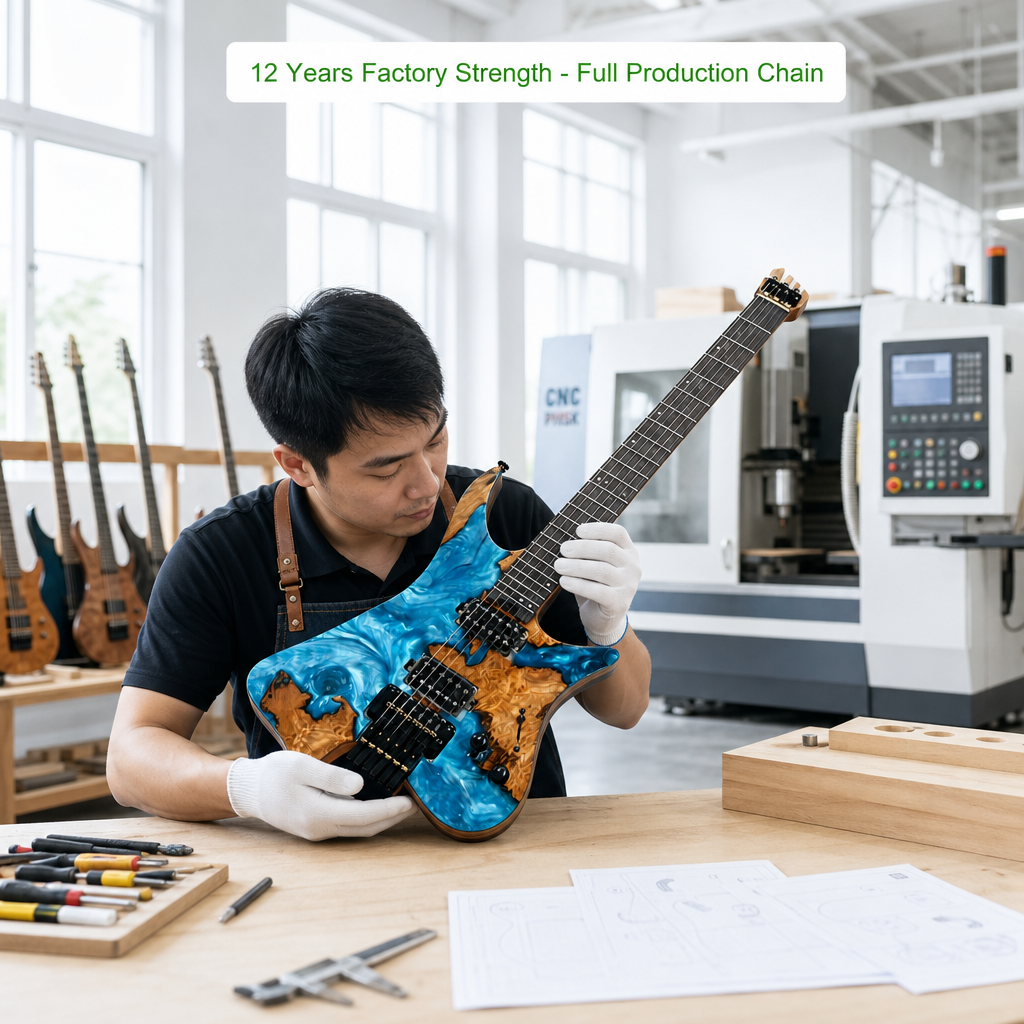
As an SGS-verified custom manufacturer, NFGF adheres to strict international quality benchmarks. Our facility integrates incoming tonewood kiln-drying chambers, multi-axis computer numerical control (CNC) shaping routers, dust-free automated spray finishing rooms, manual fret-dressing stations, and electro-acoustic testing labs. Whether supplying private-label solid wood Acacia Koa ukuleles or scaling beginner-friendly laminated basswood sets, NFGF's enterprise structure guarantees structural integrity and pristine acoustic output across every export batch.
2. Strategic Ukulele Procurement Matrix & Product Recommendations
Selecting the optimal product mix requires a nuanced understanding of consumer demographics, tonewood physics, and retail price tiers. A major vulnerability for importers is stocking generic models that lack acoustic differentiation. To optimize margin performance and minimize retail return rates, B2B buyers should align their catalog with the following empirical procurement guidelines:
| Ukulele Scale / Size | Primary Target Audience | Recommended Tonewood / Construction | Acoustic Character & Voice | Strategic B2B Focus |
|---|---|---|---|---|
| 21" Soprano (Scale 344mm) | Beginners, Children, School Curricula | Laminated Mahogany / Basswood or ABS Composite | Traditional bright, percussive, short sustain | High volume sales, low MOQ bundle kits |
| 23" Concert (Scale 385mm) | Intermediate Players, Studio & Live Use | Solid Spruce Top / Mahogany Back & Sides | Balanced mid-range, punchy projection, warm depth | Core retail sweet-spot, optimal margin tier |
| 26" Tenor (Scale 430mm) | Solo Performers, Advanced Fingerstylists | All-Solid Hawaiian Koa / Acacia or Ebony Body | Resonant bass response, extended neck reach, rich sustain | Premium boutique market, higher price point |
| 30" Baritone (Scale 510mm) | Guitarists Transitioning, Ensemble Bass | All-Solid Mahogany / Spruce with Active Pickup | Deep, guitar-like lower register (Tuned D-G-B-E) | Niche acoustic expansion, elevated margin potential |
High-Margin Recommendation: All-Solid Acacia / Koa 23" & 26" Series
For brands competing in North American and European retail sectors, consumers are increasingly seeking solid-top and all-solid acoustic tonewoods. Acacia Koa delivers a striking aesthetic flame pattern paired with lush, sparkling harmonic overtones. NFGF provides precision voicing for solid soundboards, ensuring that bridge tension and soundboard thicknessing (maintained within ±0.1mm tolerance) yield immediate acoustic resonance right out of the box.
Innovation Tier: Smart Electro-Acoustic Transacoustic Ukuleles
Equipped with onboard digital signal processing (DSP) transducers, transacoustic ukuleles allow players to project Reverb, Delay, and Chorus directly through the unamplified instrument body. This technological leap transforms standard 23" and 26" models into viral consumer items, boosting direct-to-consumer (D2C) margins by up to 40% compared to conventional acoustic models.
3. Future Industry & Design Development Trends (2025–2030)
To retain competitive dominance in search rankings and marketplace sales, global buyers must anticipate structural design shifts before they become mainstream. Based on internal R&D feedback and export analytics from Huizhou NFGF, four primary technical trends are reshaping the ukulele landscape:
1. Torrefied & Thermo-Treated Tonewoods
Climatic variation during global transit often induces timber warping or fret sprouting. Torrefaction—baking raw wood in a low-oxygen vacuum chamber at 160°C to 220°C—crystallizes natural hemicellulose and removes volatile resins. The result is a wood structure that mimics aged vintage timber, offering complete immunity to ambient humidity shifts while delivering enhanced acoustic projection.
2. Ergonomic Body Contours & Side Monitor Ports
Modern players prioritize playing comfort during extended sessions. Industrial designs now frequently feature bevelled armrests (crafted from contrasting Rosewood or Ebony) and secondary side soundholes. The side monitor soundhole directs acoustic velocity straight toward the performer's ears, delivering an intimate self-monitoring experience without altering forward sound projection.
3. High-Pressure Laminate (HPL) & Composite Hybrids
Outdoor lifestyle activities have boosted demand for durable, weather-resistant instruments. HPL technology allows manufacturers to press photorealistic wood grain films onto dense phenolic resin core sheets. These ukuleles resist temperatures up to 80°C and humidity levels down to 10%, making them ideal for travel, camping, and educational rental fleets.
By partnering with NFGF, international importers gain access to these cutting-edge structural features through our flexible OEM/ODM framework. Our engineering team routinely assists clients with custom CAD/CAM mold development, proprietary headstock shaping, and laser-etched laser rossettes.
4. Global Ukulele Procurement & Supply Chain Dynamics
The modern supply chain paradigm has pivoted away from massive, rigid inventory stocking toward agile, low-MOQ, high-turnover procurement cycles. Freight volatility, shifting international customs regulations, and fast D2C marketing cycles require suppliers to offer maximum logistical agility.
Elastic MOQ & Prototyping
Unlike traditional factories requiring 500-unit minimums per SKU, NFGF supports low-MOQ starting thresholds (from 1 to 2 pieces on selected catalog items and standard sample runs). This enables brand owners to execute live market testing and A/B campaign launches prior to committing to full 20ft/40ft container orders.
E-Commerce & Amazon FBA Readiness
Product damage during transit is a leading cause of negative merchant ratings. NFGF provides export packaging engineering, including 5-ply reinforced corrugated outer cartons, internal drop-test passed EPE foam cradles, and humidity-control desiccant pouches to guarantee safe warehouse arrival.
Regulatory Compliance Verification
Navigating environmental regulations like CITES (for rosewood and exotic species), REACH, and RoHS is vital for legal import compliance. NFGF verifies species documentation and utilizes eco-friendly water-based lacquers and non-toxic ABS components across all production lines.
5. Why Leading Global Brands Partner with Huizhou NFGF
Building an enduring brand presence requires an uncompromising manufacturing pipeline. Huizhou NFGF Musical Instrument Co., Ltd. delivers distinct operational advantages that directly enhance importer profitability and quality standards:
Integrated Luthier Craftsmanship & CNC Precision
While computer CNC machinery guarantees micrometer-accurate neck carving, fretboard slotting, and soundboard perimeter routing, human expertise remains irreplaceable for voicing bracing and hand-sanding delicate body contours. NFGF harmonizes both: automated machining eliminates human error in structural joints, while master craftsmen oversee final fret polishing, neck angle alignments, and action setups.
SGS On-Site Audited Quality Control Pipeline
Our Huizhou facility undergoes rigorous on-site evaluation by SGS Group. Every manufacturing run follows a strict 4-stage Quality Control protocol: 1) Raw timber moisture screening (8-11%); 2) In-process joint and bracing inspection; 3) Post-lacquer buffing and finish inspection; 4) Pre-shipment electro-acoustic, action height (2.5mm at 12th fret), and tuning stability verification.
Full-Spectrum OEM & ODM Customization Capabilities
NFGF provides complete private-label engineering. Our custom customization scope includes:
- Laser-etched / Pearl headstock logos
- Custom abalone & wood rosette inlays
- Pantone-matched high-gloss & satin finishes
- Solid Hawaiian Koa, Mahogany, Spruce, Ebony
- Scalloped X-bracing & fan bracing tuning
- Bone vs NuBone nut and saddle configurations
- Under-saddle piezo & Transacoustic DSP
- Custom padded gig bags (10mm–25mm padding)
- Full color retail packaging & barcoding
6. Frequently Asked Questions (B2B Procurement FAQ)
Below are authoritative answers to key technical, commercial, and logistical questions frequently raised by global musical instrument buyers and importers:
Partner with China's Premier Ukulele Manufacturer
Elevate your product catalog with high-precision, SGS-verified acoustic instruments. Contact our engineering team today to request samples, factory audits, or custom OEM pricing.