Featured OEM & ODM Instrument Solutions
Explore our top-ranking electric guitars, bass models, portable amplification, and precision accessories built to international retail specifications.


Executive Whitepaper: Strategic Sourcing of Electric Guitars from China
The global stringed musical instrument market has experienced a transformative shift over the past decade. Western brands, regional distributors, and e-commerce enterprise sellers are no longer seeking merely "cheap" labor; they are hunting for high-precision manufacturing, reliable tonewood seasoning protocols, flexible OEM/ODM batch customization, and robust intellectual property protection. Among global manufacturing hubs, the Guangdong musical instrument cluster—specifically concentrated around Huizhou—has emerged as the premier epicenter for professional-grade electric guitar, bass guitar, and acoustic instrument production.
As a leading custom manufacturer, Huizhou NFGF Musical Instrument Co., Ltd. (established in 2014) represents the modern wave of Chinese lutherie. Integrating state-of-the-art multi-axis CNC routing with meticulous hand-sanding, multi-stage lacquering, and individual electronic shielding tests, NFGF bridges the gap between boutique custom shop craftsmanship and high-volume factory scalability.
Traditional Trading vs. Direct OEM/ODM Factory Partnership
For international buyers, choosing between a third-party sourcing agent or a direct SGS-verified manufacturer fundamentally dictates product margins, quality consistency, and time-to-market. The table below highlights key structural parameters comparing traditional trading workflows against direct manufacturing partnerships with NFGF.
| Evaluation Metric | Trading Sourcing Agents | Direct NFGF Factory Partnership |
|---|---|---|
| Quality Control (QC) | Random spot checks at port of departure | 100% 8-stage in-process QC (Kiln to Final Setup) |
| Customization Level | Limited to catalog branding & simple color changes | Full ODM/OEM: Pickups, scale lengths, woods, hardware |
| Minimum Order Quantity (MOQ) | High MOQ requirements (100–300+ units per SKU) | Low MOQ flexibility (Sample runs from 1 piece) |
| Supply Chain Transparency | Subcontracted across unverified workshops | 5,100 m² unified facility with full SGS audit trail |
| Engineering & R&D Support | None; reliance on agent's non-technical staff | In-house luthiers & CAD engineers (100+ patents) |
Future Sourcing & Procurement Trends in Electric Guitar Manufacturing
Understanding where the electric guitar market is heading allows procurement directors and brand managers to future-proof their supply chains. The market is evolving rapidly due to shifting player demographics, environmental regulations, and advancements in electronic component design. Key macro trends shaping electric guitar manufacturing include:
1. Ergonomic & Headless Multiscale Guitars
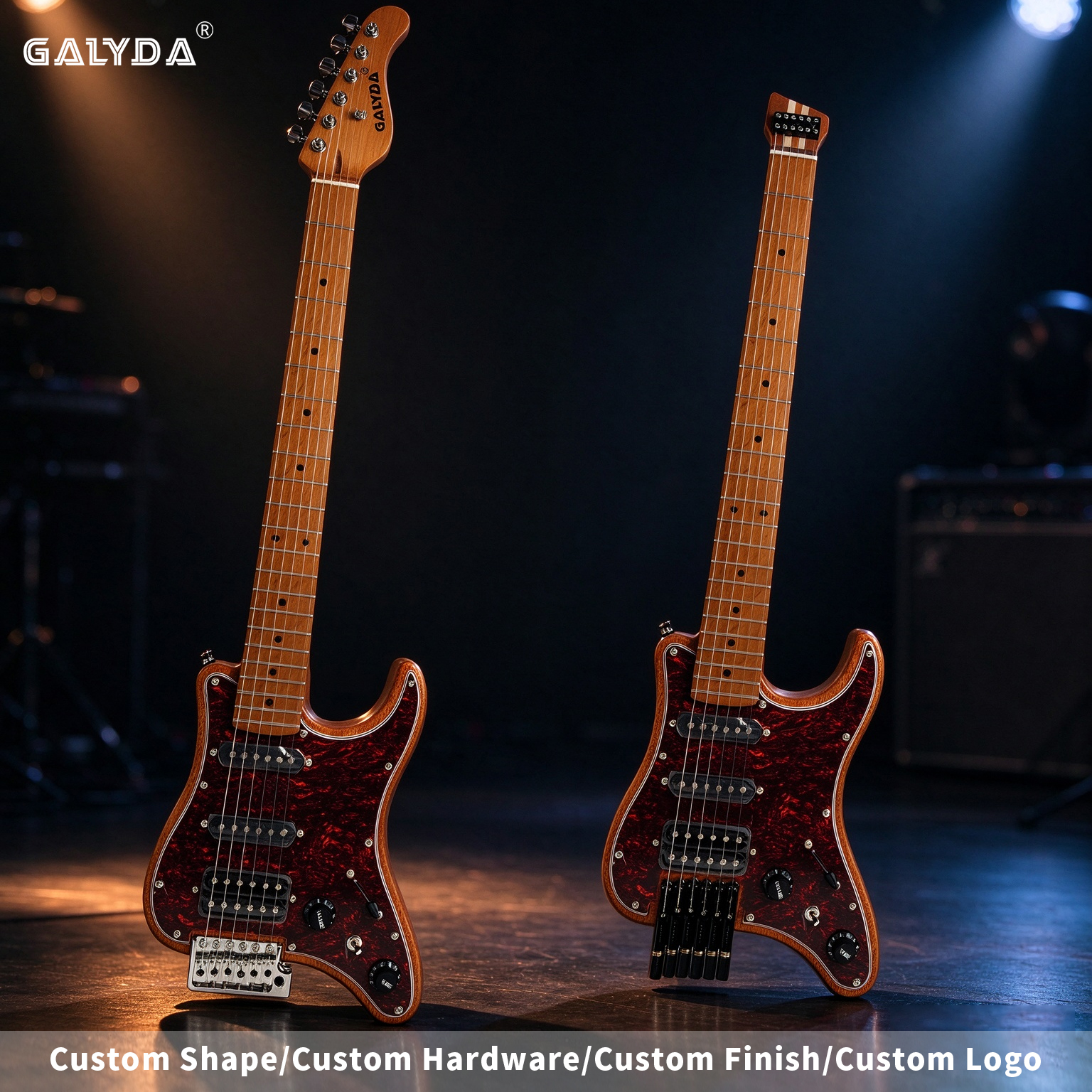
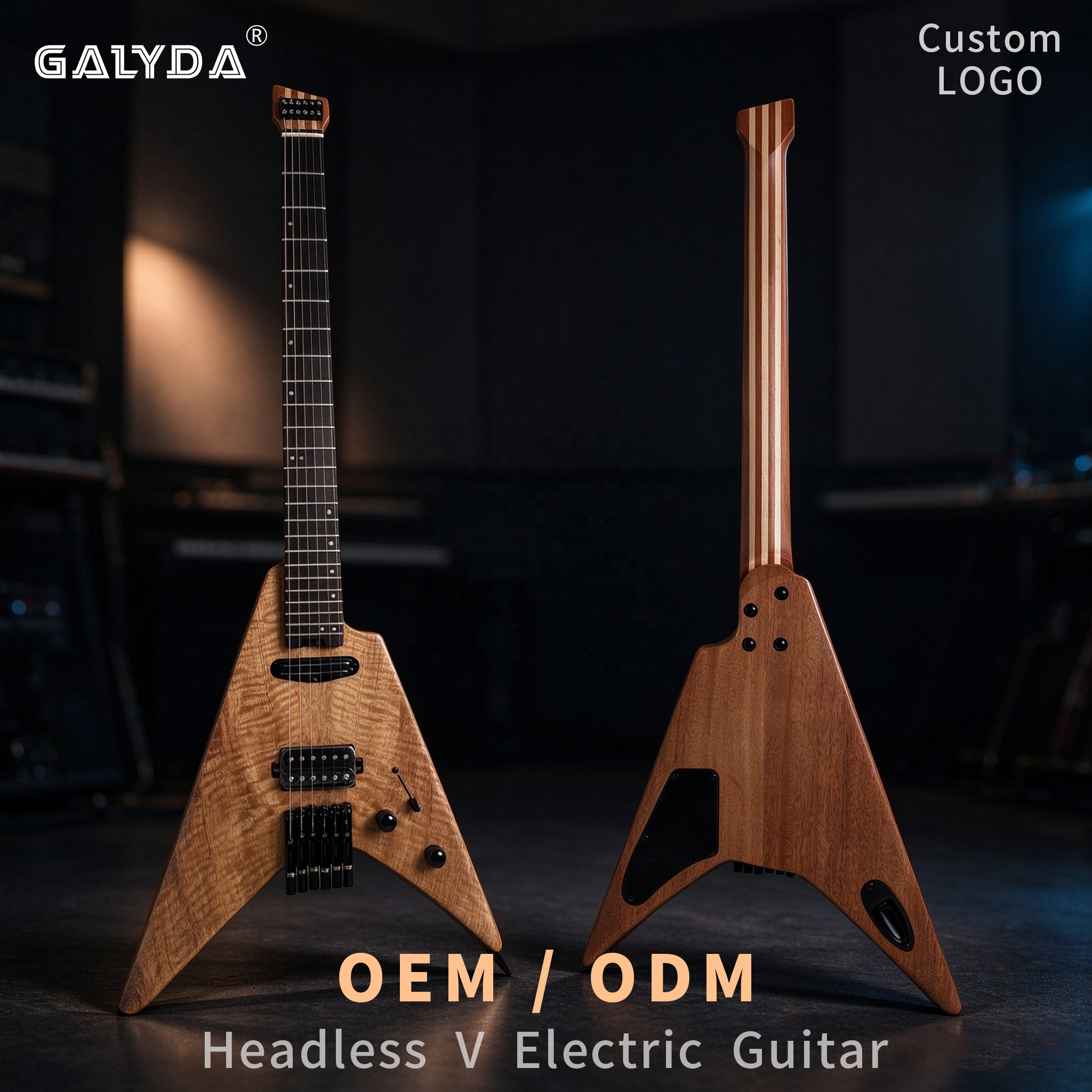
Modern guitarists demand light body weights, balanced weight distribution, and multiscale fanned-fret fingerboards that equalize string tension across low and high frequencies. Headless V-shapes and J-bass models are transitioning from niche boutique markets to mainstream wholesale demand.
2. Hybrid Pickup Configurations & Coil-Splitting
Versatility is paramount. Modern inventory requirements emphasize guitars capable of delivering both high-gain humbucker crunch and crystalline single-coil chime. Pickup layouts such as HSS (Humbucker-Single-Single) and SSH with push-pull coil-split wiring harnesses dominate buyer preference.
3. CITES-Compliant Tonewoods & Roasted Timbers
Environmental compliance and international trade laws (such as CITES Appendix II regulations on traditional Rosewood) have made thermal treatment essential. Vacuum roasting (thermo-curing) Maple and Jatoba increases wood stability, eliminates moisture reactivity during maritime shipping, and enhances tonal resonance.
Technical Industry Innovations: Thermal Treatment & Precision CNC Integration
One of the largest hidden risks in importing solid-body electric guitars and basses is neck warping and fret sprout caused by humidity fluctuations during international sea container transport. High-tier Chinese manufacturers counteract this through controlled kiln drying and computer-monitored seasoning chambers that reduce wood moisture content to a stable 8%–10% before milling.
Furthermore, automated 5-axis CNC machining ensures neck pocket tolerances within ±0.05mm. A tight neck-to-body joint is crucial for mechanical energy transfer, maximizing acoustic sustain and preventing structural play over years of heavy performance use.
Deep Industry Analysis: Anatomical Engineering of High-Performance Guitars
To establish true authority in musical instrument procurement, brand buyers must analyze the individual structural components that dictate guitar performance. Below is a breakdown of critical construction elements implemented at our Huizhou manufacturing base:
1. Body Construction & Tonewood Selection
The choice of body tonewood defines both the static weight of the instrument and its fundamental resonant spectrum:
- Solid Basswood (Tilia americana): Favored for mid-range fundamental resonance, light physical weight, and consistent grain structures. Basswood is the optimal substrate for solid opaque polyurethane and metallic gloss finishes.
- Select Mahogany (Swietenia macrophylla alternative): Delivers warm, dark low-end warmth and punchy sustain. Ideal for Les Paul (LP) style bodies, archtop contours, and high-gain modern electric models.
- Flame & Quilted Maple Veneers: Premium grade 0.6mm–1.2mm AAA maple veneers vacuum-laminated over solid body cores give brands high-end visually striking finishes without prohibitive timber costs.
2. Neck Construction, Fretwork, and Truss Rod Systems
The neck represents the primary tactile touchpoint for the musician. NFGF utilizes multi-piece neck laminations (e.g., 7-piece Maple/Walnut/Mahogany combinations on headless models) to neutralize directional wood tension. Dual-action steel truss rods are installed in every instrument, allowing bidirectional relief adjustment to accommodate varying string gauges (from .009–.042 light electric sets up to .045–.130 5-string bass sets).
Fretwork is executed using nickel-silver or stainless-steel wire. Fret ends are individually bevelled, crown-rounded, and hand-polished to eliminate sharp edges ("fret sprout") prior to final quality assurance signing.
3. Pickup Voicing & Electronic Shielding Protocols
A major cause of noise and signal hum in lower-tier imported guitars is inadequate electronic shielding. At NFGF, control cavities and pickup routing channels are coated with conductive carbon shielding paint or lined with heavy-duty copper foil. Potentiometers (250kΩ for single-coils, 500kΩ for humbuckers) are tested for taper accuracy, paired with 3-way or 5-way heavy-duty blade switches to eliminate intermittent contact pops.
Enterprise Advantages: Why Global Brands Partner with Huizhou NFGF
Selecting the right OEM/ODM manufacturing facility requires thorough auditing of production assets, workforce stability, and quality control systems. Huizhou NFGF Musical Instrument Co., Ltd. provides distinct structural advantages for international buyers:
SGS-Audited & Verified Manufacturing
Our 5,100 m² factory facility undergoes regular third-party on-site audits conducted by SGS Group (latest audit November 2025). Audits verify raw material tracing, shop-floor safety, production line efficiency, and finished goods testing integrity.
End-to-End In-House Production Line
From kiln-dried tonewood cutting, multi-axis CNC shaping, manual sanding, dust-free spray painting, and high-gloss buffing to hardware assembly and luthier setups—all processes are contained inside our own facility to guarantee quality control.
Flexible Low MOQ & Rapid Prototyping
We empower growing brands and boutique importers by offering sample runs starting at just 1 piece for key electric guitar and bass models, 2 pieces for ukuleles, and 10–100 pieces for percussion and accessory lines.
Proprietary R&D & Design Patents
Our internal lutherie design team holds over 100 design patents and intellectual property copyrights. We assist OEM client partners with co-developing exclusive body shapes, headstocks, and proprietary hardware layouts.
Our 8-Stage Quality Assurance Workflow
Quality control is not an afterthought; it is embedded into every manufacturing stage:
- Incoming Raw Timber Inspection: Moisture content verification via digital pin-meters (target 8%–10%).
- CNC Rough Shaping: Body routing, neck pocket carving, and fretboard slotting.
- Neck-to-Body Pocket Calibration: Manual alignment check ensuring flush, gap-free joint fitting.
- Multi-Stage Hand Sanding: Sequential grit sanding (180 to 800 grit) for flawless lacquer adhesion.
- Dust-Free Electrostatic Finishing: Applying multi-layer polyurethane/nitrocellulose primer, base, and clear coats.
- Precision Mechanical Buffing: High-RPM buffing wheel polish to achieve a glass-like optical sheen.
- Hardware & Electronics Wiring: Soldering harness installation, pickup height adjustment, and grounding checks.
- Luthier Playability Setup & Inspection: String action height set to 1.5mm–2.0mm at the 12th fret, intonation strobe tuning, pickup balance, and packaging drop testing.
Frequently Asked Questions (FAQ) for B2B Procurement
Below are authoritative answers to common inquiries raised by brand managers, retail procurement teams, and wholesale buyers considering OEM/ODM manufacturing partnerships with NFGF.
Ready to Build or Scale Your Electric Guitar Brand?
Partner directly with Huizhou's premier SGS-verified guitar manufacturer. Contact our engineering and export team today to request custom CAD drawings, factory factory pricing, or sample evaluation units.
Get a Quote