0%

Choosing a Classical Guitar is not simply a matter of nylon strings and a warm tone. Body shape, bracing, scale length, and construction all change how an instrument feels and sounds. A cedar-top Spanish guitar may respond quickly beneath a light touch, while a spruce top can offer a brighter attack. Flamenco models are often built for crisp projection and fast response; crossover guitars may add a narrower neck or onboard electronics.

The categories can blur. That matters.

Grand View Research’s guitar-market analysis offers useful industry context by examining broad guitar product segments, but market reports do not provide one universal classification for classical-guitar subtypes. For practical comparisons, players should also consult manufacturer specifications and listen to instruments played side by side. Andrés Segovia, the influential classical guitarist, described the instrument as “a small orchestra,” a phrase that captures its range of voices. It is an evocative description, not a buying guide.

This article explores the main types, from traditional Spanish and flamenco guitars to crossover and historically informed designs. It will compare their construction, tone, and typical playing feel, while noting where labels vary between makers. No category guarantees a particular sound. Wood, setup, and the player’s touch matter, too. By the end, readers should have a clearer way to match an instrument’s design with their music, technique, and hands.
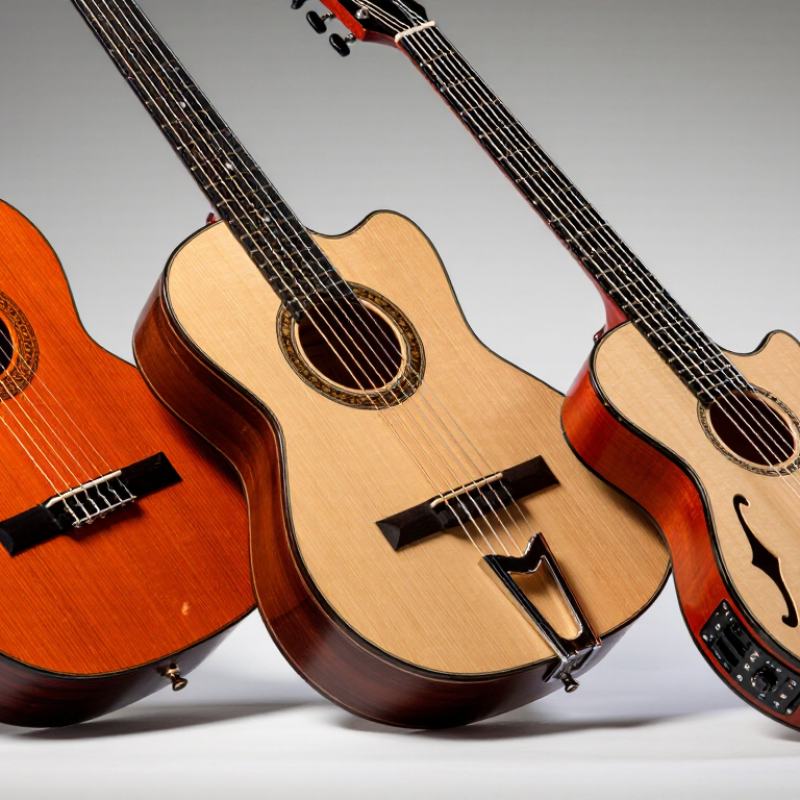
What Are the Different Types of Classical Guitar?

Traditional Concert Classical Guitars

Traditional concert classical guitars are designed for nylon strings, a broad fingerboard, and a balanced acoustic voice. Their soundboards often use fan-shaped bracing, which helps the top vibrate freely while supporting string tension. Many have a 650 mm scale length and a nut width near 52 mm, though dimensions vary between instruments.

Feel matters. The wider neck gives the left hand room for clear chord shapes, but it can feel unfamiliar to players used to narrower necks. During a quiet passage, a relaxed right-hand touch can bring out a soft, rounded note; firmer playing adds projection without the sharp edge often associated with steel strings. Small changes count.

A solid-wood top may respond differently as it vibrates with playing, while the body shape and construction also influence tone. These are tendencies, not guarantees: two guitars with similar materials can sound and feel quite different. Check the action, too. Strings set too high can make long practice sessions tiring, while an excessively low setup may cause buzzing. I still find that a guitar’s comfort is easy to underestimate until a difficult passage exposes it.

Flamenco Guitars and Their Distinctive Features

Flamenco guitars are built for sharp, lively response. Many have a spruce soundboard and cypress back and sides, though designs vary. Their lighter construction helps notes speak quickly, with a bright, dry tone that suits rhythmic playing. They use nylon strings, like classical guitars, but often have lower string action. That can make fast passages feel easier, while producing a slight buzz under a strong attack. The buzz is not always a flaw. Sometimes it adds bite.

A clear visual feature is the golpeador, a thin protective plate on the soundboard. Players tap it while playing, creating crisp clicks beside the strings. The neck and body may also feel slimmer or lighter than those of some classical guitars. Still, “flamenco sound” is not one fixed recipe. Materials, setup, and a player’s touch all shape the result.

Tips: Listen for quick decay and crisp taps. Try a few guitars with different action heights; comfort matters more than labels. A very bright tone may sound exciting at first, but can feel tiring in a quiet room. Notice that trade-off.

Crossover Classical Guitars

Crossover classical guitars combine nylon-string tone with features that feel familiar to steel-string players. Many have a narrower neck, a gently radiused fingerboard, a cutaway, and onboard electronics. The strings still feel softer under the fingers than steel strings. That matters. Chord changes may feel easier, while the warm, rounded sound suits fingerstyle, pop, and light jazz.

The details vary. Some models use a nut width near 48 mm, compared with roughly 50–52 mm on many traditional classical guitars. Check the actual specification; “crossover” has no single fixed design. NAMM’s 2024 Global Report puts U.S. music-products retail activity at roughly $17 billion in 2023, but does not separate crossover classical guitars. That broad figure shows the scale of the wider instrument trade, not crossover demand. A crossover can be practical, but its slimmer neck and pickup are compromises, not automatic upgrades.

Tips: Try a first-position barre chord, then play a quiet passage unplugged. Listen for fret buzz and uneven volume. Check whether the neck feels cramped after ten minutes. Small differences matter. A pickup can help onstage, yet amplified nylon tone may sound less natural than the guitar’s acoustic voice.

What Are the Different Types of Classical Guitar? — Crossover Classical Guitars

Crossover classical guitars usually have a slightly narrower neck than traditional classical guitars, which can feel more familiar to players of steel-string or electric guitars. These figures are representative examples, not fixed standards; specifications vary by instrument.

Acoustic-Electric Classical Guitars

Acoustic-electric classical guitars pair nylon strings with built-in electronics. They can be played without amplification, just like other classical guitars. Plugged into an amplifier or sound system, they send their sound through a pickup and onboard controls. The exact setup varies by instrument.

That flexibility helps in lessons, small performances, and recording rooms. A player can hear the guitar naturally while practicing, then connect a cable when more volume is needed. Many models include a preamp with volume and tone controls; some also have a tuner. Check the controls before buying, since a tuner or equalizer is not guaranteed.

The amplified sound may differ from what you hear beside the guitar. A pickup can emphasize string attack and reduce some room resonance. Not always flattering. Test it through the kind of speaker you expect to use, and listen for thinness or feedback at performance volume. Nylon strings also feel gentler under the fingers than steel strings, but the wider neck may take adjustment. Battery access matters, too. A dead battery before a set is an avoidable nuisance. These guitars offer convenience, though the electronics add parts to maintain and do not automatically improve the instrument’s acoustic tone. A careful setup and a suitable amplifier still matter.

Small-Body and Extended-Range Classical Guitars

Small-body classical guitars include fractional-size instruments, such as 1/2 and 3/4 sizes, as well as compact travel designs. Their shorter scale and smaller bodies can make practice more comfortable for young players or adults with smaller frames. Size labels are not fully consistent, though, so compare the actual scale length and body measurements before choosing. Comfort matters.

A smaller body may produce less volume and a lighter bass response than a full-size guitar. That is not automatically a drawback: in a small room, a clear, balanced sound can be easier to manage. Check whether your fretting hand feels relaxed, and listen for even volume across the strings. A compact body does not always mean a narrower neck, which can surprise buyers.

Extended-range classical guitars add strings beyond the standard six, commonly offering seven or eight. Extra bass strings can extend the instrument’s low range, while some designs add higher notes. Tunings and string layouts vary, so consult the instrument’s tuning chart rather than assuming the extra strings follow one standard. The wider neck may require adjusted fingering, and low notes need a controlled touch to avoid muddying chords. More range is useful, but not every piece benefits from it. A player might enjoy the added options and still find the neck tiring during long sessions.

What Are the Different Types of Classical Guitar? — Small-Body and Extended-Range Classical Guitars
Type Typical Scale Length Strings Typical Tuning Main Characteristics Common Uses and Considerations
Half-size classical guitar Approximately 530–560 mm 6 Usually standard E–A–D–G–B–E, adjusted as needed for the instrument Compact body and short scale; designed to make the fretboard easier to reach for smaller players. Often used by young beginners. Its smaller body and shorter scale produce less volume and a different feel from a full-size guitar.
Three-quarter-size classical guitar Approximately 580–630 mm 6 Usually standard E–A–D–G–B–E Smaller than a full-size instrument, with dimensions that vary between makers and models. A common choice for students or players who find a full-size guitar uncomfortable. Check the scale length rather than relying on the size label alone.
Requinto-style classical guitar Often approximately 530–570 mm Usually 6 Commonly tuned a perfect fourth above standard guitar tuning, though arrangements and tunings vary A small, high-pitched guitar related to the classical guitar family; its compact scale supports a brighter, higher register. Used for melody parts and ensemble playing. Confirm the intended tuning before using standard-guitar strings or music.
Seven-string classical guitar Often close to a full-size scale, around 630–660 mm 7 Six standard strings plus an extra bass string; the added string’s pitch and tuning vary Provides an expanded lower range while retaining the general playing layout of a classical guitar. Useful for bass lines, chord extensions, and repertoire requiring additional notes. The extra string may require a wider nut and a revised fingering approach.
Eight-string classical guitar Often close to a full-size scale, around 630–660 mm 8 Configurations vary; extra strings may extend the bass range, the treble range, or both Offers a broader range than a six-string guitar, but string placement and tuning are not standardized. Selected for specific repertoire and arrangements. Players should check the instrument’s tuning and string layout before choosing music or a fingering system.
Ten-string classical guitar Often close to a full-size scale, around 630–660 mm 10 Varies by instrument; additional strings may be tuned as basses or resonance strings Provides extra notes and, in some designs, sympathetic resonance from strings that are not fretted in the usual way. Used for specialized repertoire and arrangements. The wider string set requires adapted technique, and tuning conventions differ between instruments.
Note: Dimensions and tunings are typical examples, not fixed standards. Actual scale length, body size, string spacing, and tuning can vary by instrument and intended use.

FAQS

What gives a flamenco guitar its bright, quick sound?

Many use a spruce soundboard with cypress back and sides. Lighter construction helps notes respond quickly and decay fast.

Is a slight buzz on a flamenco guitar a defect?

Not always. Lower string action can make fast playing easier, while a strong attack may create a little buzz. Listen for the sound you prefer.

What is the golpeador for?

It is a thin protective plate on the soundboard. Players tap it for crisp clicks beside the strings. Small detail, clear sound.

How can I choose a comfortable flamenco guitar?

Compare guitars with different action heights. Listen for quick decay and sharp taps. A very bright tone may become tiring in a quiet room.

Who might prefer a small-body classical guitar?

Its shorter scale and smaller body may suit young players or adults with smaller frames. Check the actual measurements; size labels can mislead.

Does a compact classical guitar always have a smaller neck?

No. A smaller body does not guarantee a narrower neck. Check your hand position and listen for even volume across the strings.

What do extra strings offer on an extended-range classical guitar?

Seven- or eight-string designs can add bass notes, and some offer higher notes. Tuning layouts vary, so check the instrument’s tuning chart.

Are extended-range guitars right for every player?

No. Wider necks may need adjusted fingering, and low notes can muddy chords if played too forcefully. More range sounds useful, but I might still find the neck tiring during long sessions.

Conclusion

Classical Guitar designs vary to suit different players, settings, and musical styles. Traditional concert models are made for nuanced acoustic performance, with a wide neck and nylon strings that support a warm, expressive tone. Flamenco guitars are typically built to feel responsive and produce a brighter, more percussive sound, making them well suited to the lively rhythms of flamenco music. Crossover models combine familiar classical features with a narrower neck or other details that may feel more accessible to players coming from steel-string or electric guitar.

Acoustic-electric classical guitars include built-in electronics, allowing their sound to be amplified for performances or recording while retaining nylon strings. Small-body instruments offer a more compact, comfortable option for travel or players who prefer a smaller guitar. Extended-range models add strings beyond the standard six, expanding the available notes and tonal possibilities. Understanding these differences can help players choose an instrument that matches their technique, comfort, and musical goals.

Ethan

Ethan

Ethan is a professional marketing specialist with a deep understanding of the company’s products, services, and the needs they are designed to address. He regularly contributes expert articles to the company website, sharing practical insights, clear explanations, and useful guidance to help......